From Fault to Regulatory Report: The Invisible Gap

Your asset management system is documented. Your teams know ISO 55001. Your ERP is running. But when the regulator demands 5 years of complete traceability for each structure — from a photograph of a damaged insulator to maintenance notice closure — how many hours does it take to reconstruct that evidence?
This article explores a common operational reality in transmission companies: the void between field inspection data capture and its structured integration into maintenance workflows for conductors, insulators, hardware, and structures.
Context: Integrity Management in Transmission
Transmission operators in Latin America face regulatory requirements that demand formal integrity management systems. These systems — called SGIIE in Chile, or equivalents in Brazil, Colombia, and Peru — share a common denominator aligned with ISO 55001 principles.
The core requirement: Complete traceability of the fault → maintenance notice → intervention closure cycle, with photographic evidence of conductor, insulator, hardware, structure, and right-of-way condition.
Data retention — Chile example: The NTSyCS (Technical Standard for Service Security and Quality, Chile) requires calculating Forced and Programmed Unavailability indices with a 5-year (60-month) rolling window. This means when the regulator audits, they need access to data from up to 60 months back. Can you reconstruct complete traceability from the field photograph to notice closure for a structure inspected 4 years ago?
The operational challenges we describe here are common to transmission companies across the region, regardless of the specific regulatory framework. The difference lies in the ability to demonstrate compliance when audited.
Regulatory Frameworks in Latin America
Traceability requirements exist throughout the region, though with different names:
| Country | Regulatory Framework | Main Focus |
|---|---|---|
| 🇨🇱 Chile | RPTD N°17 + NTSyCS | SGIIE, 5-year traceability, SEC audits |
| 🇧🇷 Brazil | ANEEL Resolution 906 | Right-of-way, preventive maintenance |
| 🇨🇴 Colombia | CREG Requirements | Asset availability, quality indicators |
| 🇵🇪 Peru | OSINERGMIN Standards | Electrical facility supervision |
Common denominator — ISO 55001: All these regulatory frameworks share principles aligned with ISO 55001 for asset management. The core requirement is consistent: complete asset lifecycle traceability, which means documenting faults from detection through resolution.
Visualizing the Gap
Manual traceability
The Operational Challenge
Definition: The structuring gap is the operational void between field visual inspection data capture (photographs of conductors, insulators, structures) and its structured integration into the asset management system with complete traceability of the fault → notice → closure cycle.
Transmission companies have mature asset management systems. In Chile, RPTD N°17 has required since March 2024 the implementation of SGIIE in compliance with NCh-ISO 55001. They have reliability teams with years of experience inspecting conductors, insulators, and structures. However, connecting visual line inspection data with those systems remains a significant operational challenge.
The symptom: Administrative hours dedicated to collecting tower photographs from different sources, standardizing fault formats according to company taxonomy, and manually generating regulatory reports.
Where line inspection data lives today
- Inspector local folders — thousands of photographs of conductors, insulators, and structures without structured metadata
- Emails — span and tower inspection reports as PDF attachments
- Scattered Excel spreadsheets — each contractor with their own fault classification format
- Legacy systems — historical data from previous inspections in non-migratable formats
Where they should be
- Central repository — all line images with georeferencing and capture metadata
- Classified faults — failure modes in conductors, insulators, hardware, and structures according to your company's taxonomy
- Asset linking — line, circuit, structure, span, phase, component with complete traceability
- Structured data — ready to import into your ERP or asset management system
The Real Cost of the Gap
The data gap isn't an abstract technical problem. It has measurable operational costs in transmission line management:
1. Administrative burden
Each line inspection cycle generates manual work: consolidating information from different flight providers, standardizing tower and span nomenclatures, linking component photographs with registry assets, and formatting data for management systems. This work adds no value — it's operational cost generated by the gap.
2. Information latency
When conductor and insulator condition data takes weeks to reach the planning team in structured form, maintenance decisions are made with outdated information. A critical fault on an insulator detected in March may not generate a maintenance notice until May.
3. Audit risk
Regulatory frameworks require demonstrating the complete fault → notice → closure cycle. If that traceability depends on manually reconstructing the connection between a structure photo in a folder and a notice in the ERP, the risk of non-compliant faults is high.
4. Inconsistent data quality
Without standardized evaluation criteria according to company taxonomy, the same failure mode in a conductor or hardware may be classified differently depending on the inspector or contractor. This inconsistency contaminates reliability indicators and hinders trend analysis by component type.
What to Look for in a Solution
A platform that closes the line inspection data gap must integrate with your existing ecosystem, not replace it. These are the relevant criteria:
Line capture data centralization
- Single repository for all tower, conductor, and component inspection images (RPAS, thermography, visual)
- Automatic metadata: structure GPS, timestamp, capture equipment, operator, line and circuit
- Photographic quality control before processing — complete span and component coverage
- Complete traceability from field capture to classified fault
Structured condition assessment
- Failure mode classification in conductors, insulators, hardware, and structures according to your company's taxonomy
- Severity levels consistent with your internal prioritization criteria
- Validation by electrical engineers with transmission line experience
- High-resolution images of each component linked to each fault
Integration with existing workflows
- Structured export (CSV, Excel, KMZ) compatible with your ERP
- Data formatted according to your management system's asset structure
- Maintenance notice generation with attached photographic evidence
- Report formats compatible with your regulatory requirements
Line maintenance decision support
- Condition visualization by line, circuit, structure, and component type
- Temporal condition evolution of conductors, insulators, and hardware
- Operational risk matrices for intervention prioritization
- Historical data for recurrent failure mode analysis by asset type
How Automapp Cloud Closes the Gap
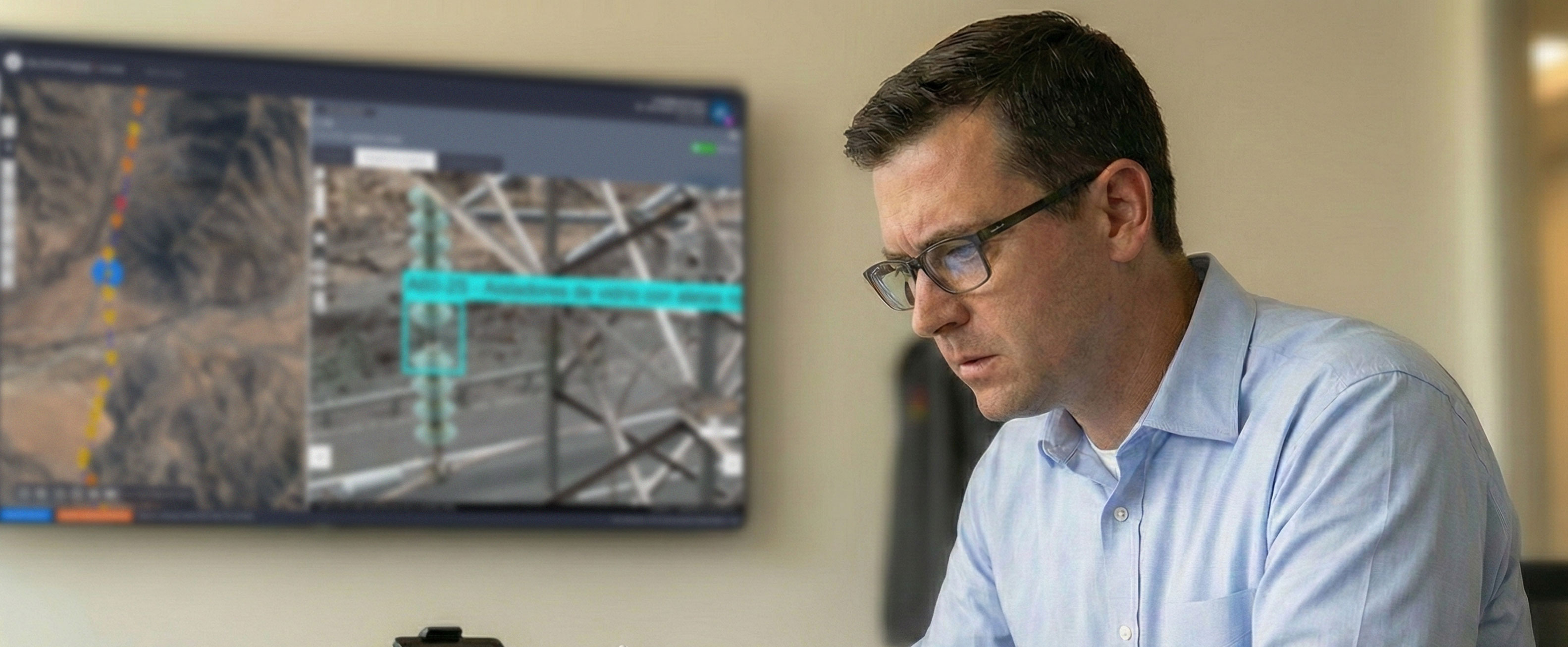
Automapp Cloud is the Visual Inspection Intelligence Platform for transmission lines. It processes capture data from conductors, insulators, hardware, and structures, and transforms it into structured faults ready to feed your existing maintenance workflows.
Specialized analysis layer: We process line inspection data and deliver it structured according to your company's taxonomy, ready to integrate with your existing systems.
What we do
| Module | Function | Result |
|---|---|---|
| Capture | Coordinates flight operations, photographic quality control of towers and components, automatic upload | Central line image repository with complete traceability |
| Analysis | Human evaluators assisted by AI detect failure modes in conductors, insulators, hardware, and structures | Faults classified by severity according to your company's taxonomy |
| Planning | Condition visualization by line and structure, notice generation, structured export | Data ready to import into your ERP |
Operational results
- Reduced administrative hours: Eliminates manual work of consolidating, standardizing, and formatting line inspection data
- Auditable traceability: Each fault in conductors, insulators, or structures linked to its source image, with structure georeferencing and complete metadata
- Evaluation consistency: Uniform classification criteria according to your company's taxonomy, applied by electrical engineers with AI assistance
- Integration with existing systems: Structured exports (CSV, Excel, KMZ) compatible with your ERP
Transmission line knowledge base
- 300,000+ faults processed in conductors, insulators, hardware, and structures from LATAM lines
- 40+ AI models trained specifically for transmission line components
- 22,000+ km of lines evaluated in production
- Transelec, ISA, ENGIE, Celeo — leading transmission companies in Latin America that have trusted us
Does your line management have an inspection data gap?
Talk to our team about how Automapp Cloud can integrate with your existing line maintenance workflows. Structured data from conductors, insulators, hardware, and structures ready to feed your ERP.
mail Request InformationAdditional Resources
gavel Regulatory Frameworks
verified International Standards
- ISO 55001:2014 — Asset management
- ISO 55002:2018 — Guidelines